
AIRCRAFT INTERIORS · REVERSE ENGINEERING
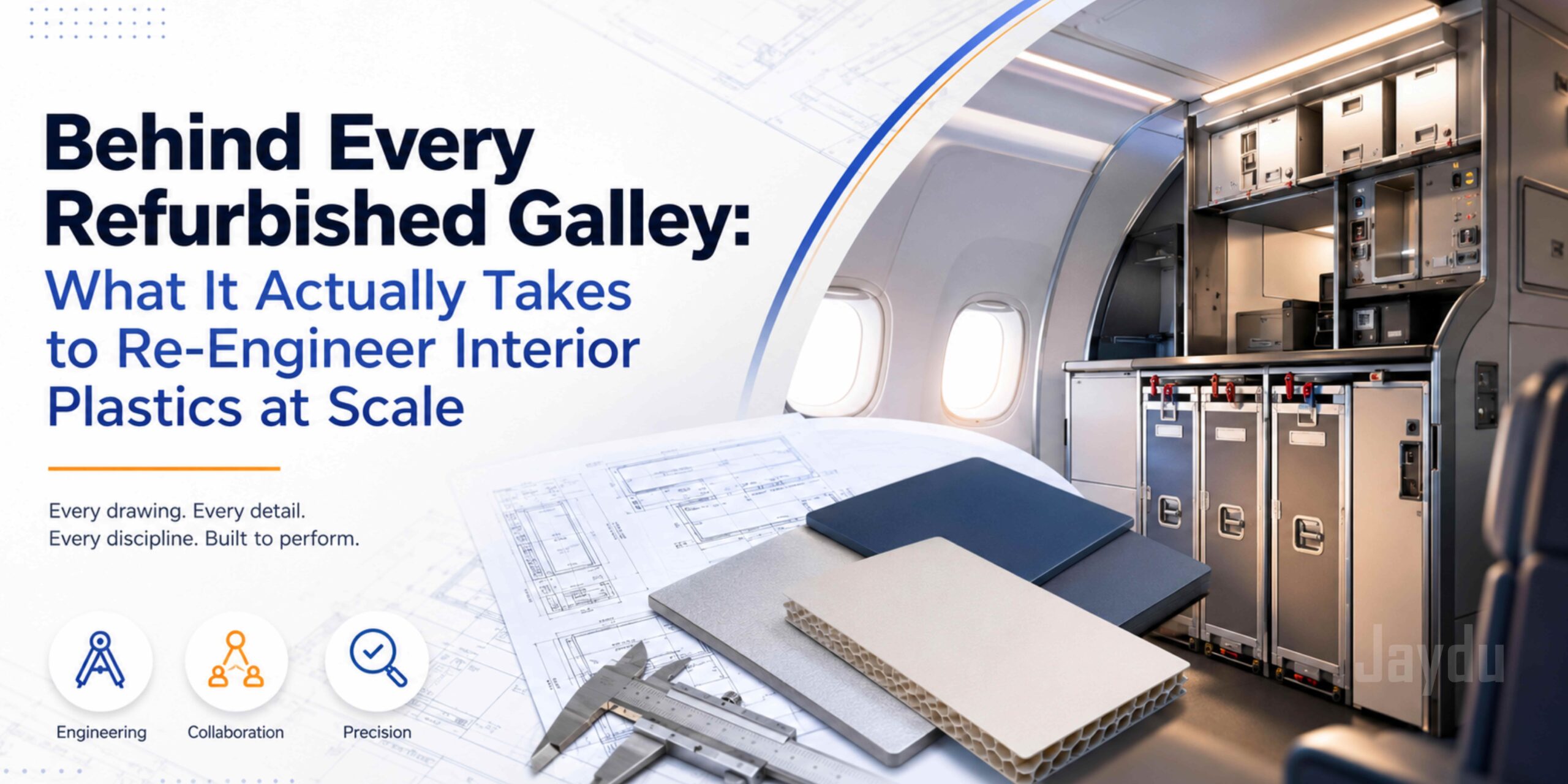
Behind Every Refurbished Galley
What it Actually Takes to Re-Engineer Interior Plastics at Scale
A closer look at what it takes to re-engineer interior plastics at scale — where feasibility work, CATIA modeling, and change management had to move together, on schedule.
SIGNATURE DETAIL
Every drawing has to survive certification, years later.
Galley plastics are certified installations. A dimensional change on paper is also a decision someone will have to defend on an audit.
01 · CONFIGURATION REALITY
A galley never matches its own drawing set
Years of service bulletins, minor repairs, and supplier substitutions leave a fleet drifting quietly away from the OEM baseline. Interior plastics sit at an odd intersection: not structural in the load-bearing sense, but certified installations all the same.
Every dimensional change or material substitution needs an engineering rationale a certifying authority will eventually review — while the parts themselves absorb thermal cycling, hinge wear, and years of cart traffic.
A refurbish/retrofit program has to solve fit, finish, and service life at once, without triggering a full requalification cycle it can avoid.
02 · INTEGRATED ENGINEERING
Three disciplines, held together at once
The CATIA-based design work followed a familiar pattern: reverse-engineering existing geometry, rebuilding models to reflect as-built configuration, and producing the documentation trail that lets certification move forward without re-litigating design decisions.
The less visible part was change management — tracking engineering change requests from teardown findings and supplier feedback, and keeping the design record consistent as the program moved.
Engineering Judgment
Catching a mold change or retest hiding inside a “simple” swap.
Documentation Discipline
A drawing package that holds up to review years later.
Configuration Control
A design record that stays honest as scope evolves.
Engineering delays on a refurbishment program translate directly into aircraft-on-ground cost. Schedule wasn't a secondary metric here — it was the deliverable.
On program priorities — Jaydu Engineering Team
03 · PROGRAM DELIVERY
Why on-time performance was the real deliverable
MRO refurbishment programs are almost always executed against aircraft-on-ground economics or a revenue-service deadline. Jaydu's contribution came from two decisions: treating the program plan as a shared commitment, and scaling the design team up as workload increased — rather than waiting for a renegotiation cycle.
Static Scope
Growing Scope
Program Delivery
SCHEDULE ECONOMICS
A “simple” scope rarely stays simple.
Rolling ECRs and evolving feasibility findings are normal on legacy interior programs—capacity has to flex with them, not wait for a change order.
04 · PARTNER EVALUATION
What this signals for evaluating a design partner
Most partners can produce a CATIA model. The differentiator is whether a partner can hold engineering judgment, documentation discipline, and operational flexibility together — at the same time, for the life of the program.
AIRCRAFT INTERIOR ENGINEERING