
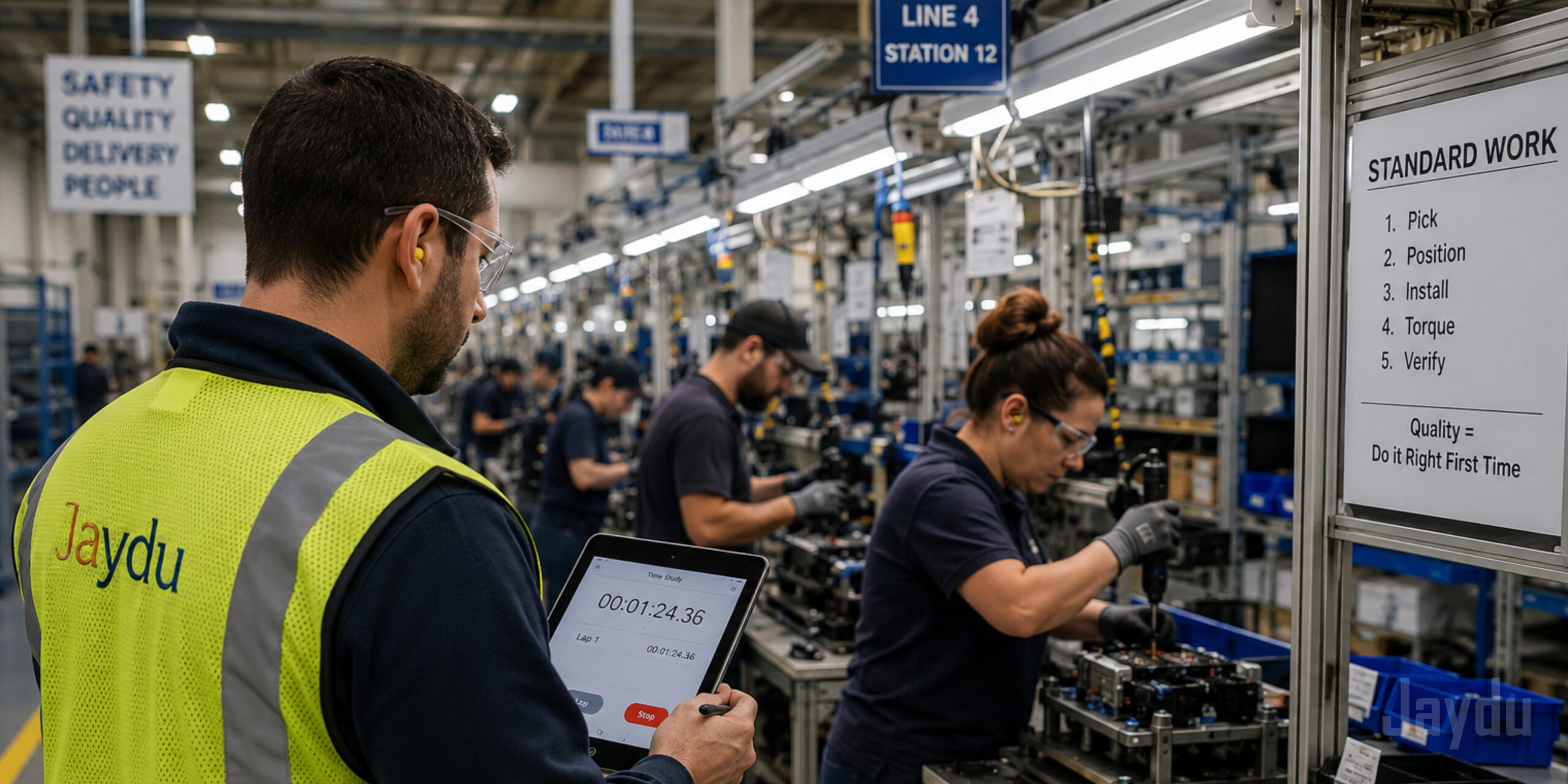
From Chaos to Consistency: Using Time Studies to Build Bulletproof Standard Work
A measured path from operator-to-operator variation to repeatable, floor-ready processes that hold up through demand changes, audits, and workforce turnover.

The Problem No One Wants to Admit
Walk into most U.S. manufacturing facilities and you will find a familiar scene — operators performing the same job in three different ways, supervisors firefighting daily instead of managing production, and floor leaders who cannot explain why output drops every time a key person calls out sick.
The root cause is almost never a machine problem or a labor problem. It is a process stability problem. And the fastest path to fixing it starts with two things most operations underinvest in: time studies and standard work.
Jaydu's Manufacturing Engineering team — operating out of Alpharetta, GA — embeds directly on your production floor to turn that instability into repeatable, measurable consistency.
What a Time Study Actually Does — and What It Doesn't
A time study is not a way to clock-watch your workforce. It is a structured engineering method to capture how long each task element takes under normal conditions — so you have a reliable, factual baseline for what good performance actually looks like.
Done correctly, a time study reveals:
Without that data, standard work is built on guesswork. And guesswork does not hold up when a new operator joins, demand spikes, or a customer audit walks through your door.
The 5-Step Process: From Time Study to Standard Work
Jaydu's Industrial Engineering and Lean/CI teams embed directly with your crew — onsite or nearshore. Here is exactly how the engagement runs from first observation to floor-ready standard work:
Observe
Onsite team embeds with your crew. Full process mapping and task inventory.
Capture
Structured time data captured across operators and multiple shifts.
Analyse
Each task broken into value-add vs. non-value-add elements. Waste identified.
Calculate
Performance rating and allowances applied. Validated standard times produced.
Document
Work instructions, takt alignment, and operator guides built and handed over.
| STEP | ACTIVITY | JAYDU'S ROLE | OUTCOME |
|---|---|---|---|
| 1 — Observe | Process mapping | Onsite team embeds with your floor crew | Full task inventory & cycle map |
| 2 — Capture | Time data collection | Structured data capture across shifts | Accurate cycle time per element |
| 3 — Analyse | Elemental analysis | Value-add vs. waste breakdown per task | Waste identified at task level |
| 4 — Calculate | Standard time | Rating & allowances applied | Validated standard times |
| 5 — Document | Standard work build | Work instructions, takt alignment, guides | Floor-ready — deployable next day |
Why Standard Work Fails Without Time Studies
Many manufacturers have attempted standard work before and found it didn't stick. The most common reason: the standards were built on assumptions, not measured data. When a standard time is set by a manager's estimate rather than a timed observation, it has no credibility on the floor.
Operators know immediately when a standard is wrong. If it is too tight, they find workarounds. If it is too loose, the efficiency gains are never captured. Either way, the document becomes shelfware within weeks.
Time studies fix this by giving standard work a factual foundation. When operators can see their best-practice method was timed, analyzed, and validated — adoption is dramatically higher, and the standard holds through personnel changes.
The Connection to Lean, Takt Time & Workforce Stability
Time studies and standard work are the foundation for everything else in Lean and Continuous Improvement. Once standard times are validated, your team gains real leverage:
Balance workloads to takt time
Distribute tasks evenly so no station is overloaded or sitting idle during a shift.
Identify bottleneck stations
Pinpoint exactly which step is constraining your total line throughput with real data.
Build training on best methods
New operators learn from the validated standard — not from whoever sits next to them.
Measure Kaizen results with data
Compare before and after each improvement event using measured standard times.
Scale output confidently
Add volume or new lines knowing your process is documented, repeatable, and stable.
Retain knowledge through turnover
When a skilled operator leaves, the standard stays. New hires ramp faster and safer.
Flexible Engagement for U.S. Manufacturers
Jaydu works with manufacturers through three engagement models. For time studies, most engagements start onsite — where direct process observation is critical — then shift into documentation and coaching phases.
- Engineers embed on your floor
- Direct process observation
- Rapid feedback loops
- Best fit for time study phase
- Aligned working hours
- Real-time collaboration
- Fast decisions, low delays
- Cost-effective & responsive
- Significant cost savings
- Standard work documentation
- Follow-the-sun productivity
- Scalable for large deliverables
Stop Running on Tribal Knowledge
If your production floor runs on inconsistent cycle times, undocumented processes, or varies operator to operator — Jaydu can build the structured foundation your operation needs to grow reliably.
Talk to Jaydu's Team →