
Bridging the Gap Between ERP Systems and Shop Floor Reality in Manufacturing Operations
When planning data and production reality drift apart, every team makes reasonable decisions from a different version of the truth. Closing that gap starts with process and master data—not another layer of software.
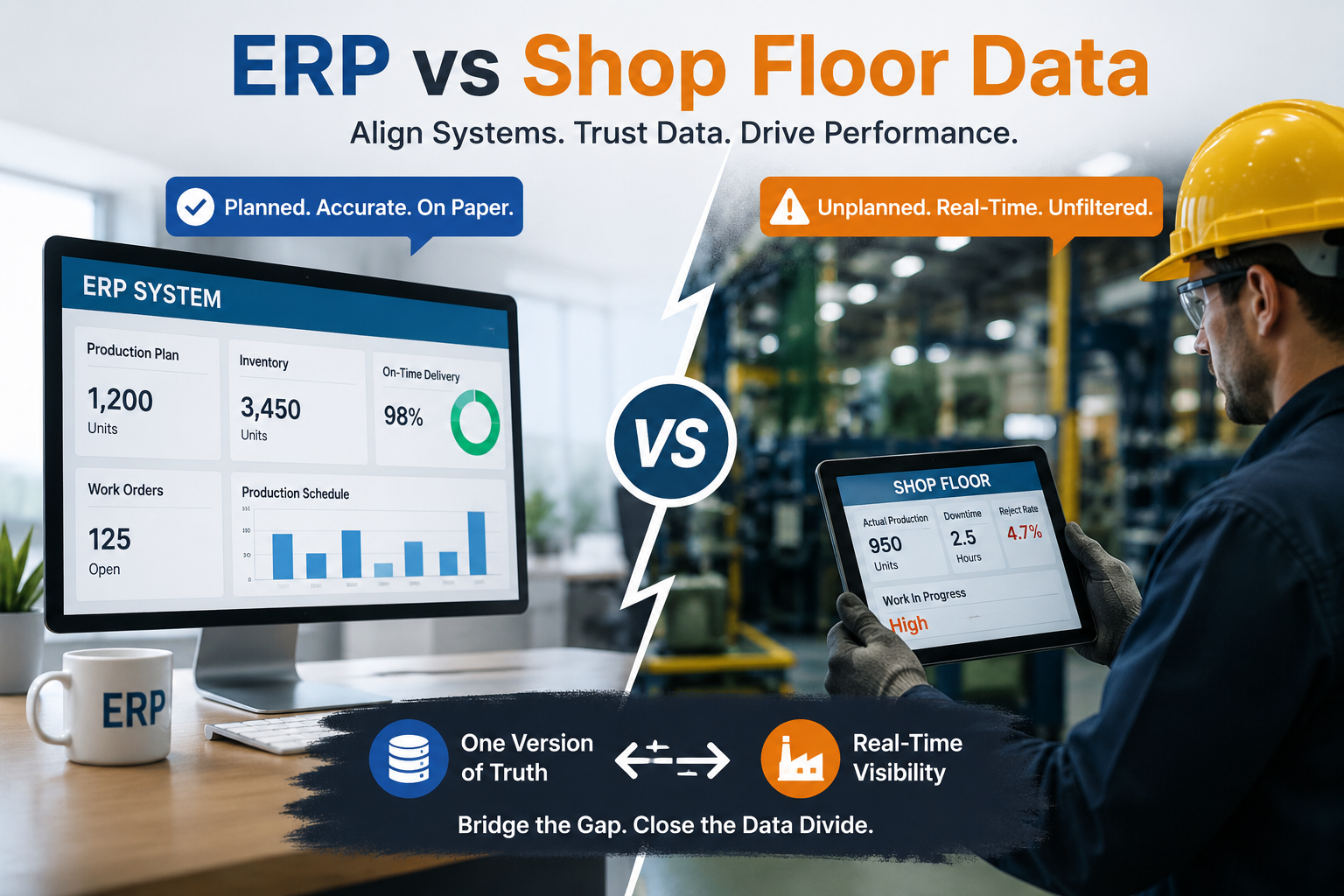
Everyone Is Working From Different Data—and Technically, Nobody Is Wrong
The production report on your desk shows 94% schedule adherence. Yet, your shift supervisor just walked in to report that three major jobs are tracking behind. Meanwhile, sales is quoting margins based on labor hours that haven’t reflected actual shop floor reality in two years.
Ensuring accurate data on the ERP shop floor is essential for operational efficiency. Understanding the dynamics of the ERP shop floor is crucial to mitigating expensive operational drains.
This is the ERP shop floor data gap. Across discrete manufacturing, it is one of the most expensive operational drains—primarily because it never shows up as a line item on the books.
It’s Not an ERP Problem. It’s a Process Problem.
When production and planning fall out of sync, the knee-jerk reaction is to blame the software. Leadership assumes it’s an outdated configuration, the wrong platform, or a botched implementation.
But in most manufacturing environments, the ERP is doing exactly what it was configured to do. The real issue? It was configured around a version of production that no longer exists.
Over months and years, a massive variance opens up through undocumented shifts in daily operations:
Informal Routing Updates
Operators develop brilliant, undocumented workarounds for tooling constraints or machine quirks.
Optimistic Planning
Setup durations get underestimated in MRP, leaving the floor to quietly compensate.
The Production Conflict
Modern facilities have terminals, scanners, and tablets. But when accurate entry competes with a production target, operators choose production every time.
The Three Root Causes Behind the Variance
Improving the ERP shop floor framework before adding new technology is crucial. To fix the divide, manufacturers must address three structural friction points:
Transaction Timing Latency
The ERP assumes production events are recorded sequentially in real time. The floor records them when there is a break in production. For high-mix, low-volume operations with frequent changeovers, WIP status becomes a lagging indicator. Every downstream planning decision is compromised because it is based on stale data.
Master Data Drift
Routings, cycle times, setup standards, and Bill of Materials structures change through engineering improvements, tooling modifications, and supplier substitutions. If these are not fed back into the system, the ERP calculates costs against a fantasy.
No Ownership at the Transaction Boundary
Production owns making physical parts. Data entry is treated as administrative overhead—something that happens around production, not as part of it. Without clear ownership, data quality degrades to the minimum needed to close a work order.
Remediate Before You Automate
Fixing the ERP-to-shop-floor divide requires a strict sequence: process and master data redesign first, technology investment second.
Master Data Remediation
Audit and update legacy routings, reconcile BOMs, and reset cycle times against physical time studies.
Workflow Realignment
Redesign shop floor transaction workflows so data logging is embedded naturally into the operator’s physical movement.
Governance & Ownership
Define ownership at the transaction boundary so accurate data becomes an operational responsibility and drift does not recur.
How Jaydu Engineers the Real-World Solution
The ERP–shop floor gap sits at a frustrating intersection. It is not a pure IT problem, and it is not a pure operations problem. Because it rarely has a strict “ship date” attached to it, it frequently falls through the cracks.
Collaboration between teams on the ERP shop floor ensures smoother operations. This is where an engineering partner with hands-on manufacturing expertise changes the equation.
Jaydu bridges this gap not as a software integrator, but as an engineering authority. We look at your systems through the lens of manufacturing process design, asset utilization, and human factors on the shop floor.
What We Deliver
Comprehensive Gap Analysis
Pinpointing exactly where physical cycle times and digital standards diverge.
Master Data Remediation
Re-engineering legacy BOMs and routings so the ERP reflects how the shop actually operates.
Workflow Optimization
Designing low-friction, high-accuracy data workflows that respect operators’ time and shop-floor constraints.
Optimizing workflows on the ERP shop floor can increase operational efficiency. A well-structured ERP shop floor can provide a competitive edge, while understanding shop-floor needs fosters better communication and collaboration.
Ready to Bring Absolute Visibility Back to Your Manufacturing Operations?
Jaydu partners with discrete manufacturers to align engineering design, ERP data, and shop floor reality.
Contact our engineering team